 Pin It
 My kitchen smelled like a Parisian bakery the morning I finally nailed sourdough croissants—not because I'm French, but because my starter had been bubbling away for weeks, waiting for its moment. There's something almost magical about layering butter and dough, watching them transform into those golden, flaky crescents that shatter when you bite them. This recipe came together after I stopped overthinking the process and started trusting the overnight rest, which does most of the heavy lifting for you.
I brought a batch to my neighbor one Saturday morning, still warm from the oven, and watched her face light up in a way that made every fold and chill cycle worth it. She asked for the recipe immediately, then admitted she'd been intimidated by croissants her whole life—but something about the sourdough connection made it feel less scary and more like an adventure we could share.
Ingredients
- Bread flour (500 g): This higher protein content gives croissants their signature structure and helps develop the gluten network you need for those delicate layers.
- Granulated sugar (60 g): Just enough to feed your starter and balance the tangy sourdough flavor without making these sweet.
- Fine sea salt (10 g): Always measure salt carefully—it controls fermentation and strengthens the dough, but too much will ruin everything.
- Cold whole milk (240 ml): Cold temperatures matter here because you want the dough to stay cool during mixing, which keeps the butter from bleeding into the flour.
- Active sourdough starter (100 g at 100% hydration): This is your secret weapon for flavor depth; if your starter seems sluggish, feed it 4-6 hours before using and look for visible bubbles.
- Unsalted butter for dough (30 g): Softened butter mixes in smoothly, while the large block stays cold and laminated to create layers.
- Cold unsalted butter block (250 g): Use a reliable butter thermometer—you want this around 16-18°C (60-64°F) when laminating, pliable but not soft.
- Egg wash (1 egg and 1 tbsp milk): This creates that gorgeous golden-brown finish and helps the croissants puff dramatically in the oven.
Tired of Takeout? 🥡
Get 10 meals you can make faster than delivery arrives. Seriously.
One email. No spam. Unsubscribe anytime.
Instructions
- Mix your dough base:
- Combine flour, sugar, and salt in a large bowl, then add cold milk, your bubbly starter, and softened butter. Mix until shaggy, then knead for about 8 minutes until the dough becomes smooth and elastic—you should feel resistance but no stickiness.
- Chill the dough:
- Shape it into a rectangle, wrap it tightly, and refrigerate for at least 2 hours (or up to overnight). This rest lets the gluten relax and helps everything chill properly before laminating.
- Prepare your butter block:
- Place cold butter between two sheets of parchment paper and pound it gently with a rolling pin until it forms a flexible 20 x 15 cm rectangle. If it cracks at the edges, that's fine—just press it back together and chill again until it's firm but still slightly pliable.
- Laminate—first fold:
- Roll your chilled dough into a 40 x 20 cm rectangle on a lightly floured surface. Place the butter block on one half, fold the other half over it, and press the edges to seal. Turn the dough 90 degrees and roll it out to 60 x 20 cm.
- Letter fold and chill:
- Fold the long rectangle into thirds like a business letter, wrap it, and refrigerate for exactly 1 hour. This resting period prevents the dough from tearing and lets it relax between folds.
- Repeat the turns:
- Do two more rounds of rolling, folding into thirds, and chilling for 1 hour each. By now your dough will feel silky and cooperative, and the butter will be evenly distributed into thin layers.
- Final overnight rest:
- After your third fold, wrap the dough and refrigerate for 8-12 hours. This is when the magic happens—the dough develops flavor from your starter, and the layers become distinct and flaky.
- Shape your croissants:
- The next morning, roll the dough into a 60 x 30 cm rectangle about 5 mm thick. Using a sharp knife, cut it into 12 long triangles with a clean motion—jagged cuts create uneven layers.
- Roll and crescent:
- Start rolling each triangle from the wide end toward the point, gently stretching it as you go, and tuck the tip underneath. The gentle stretch helps create that signature elongated crescent shape.
- Proof until puffy:
- Place croissants on parchment-lined baking sheets, cover loosely with a clean kitchen towel, and let them rise at room temperature for 2-3 hours until noticeably puffy but still slightly springy when touched.
- Prepare to bake:
- Preheat your oven to 200°C (400°F) for at least 15 minutes. Whisk the egg with milk and brush a thin, even coat over each croissant—not so much that it pools, but enough to create shine.
- Bake until golden:
- Bake for 18-22 minutes, watching for deep golden-brown color and a crispy exterior. If your oven runs hot, tent them loosely with foil halfway through to prevent over-browning.
- Cool and serve:
- Let them cool for 5-10 minutes on the baking sheet so the structure sets, then transfer to a wire rack. They're best eaten warm or at room temperature within a few hours of baking.
 Pin It
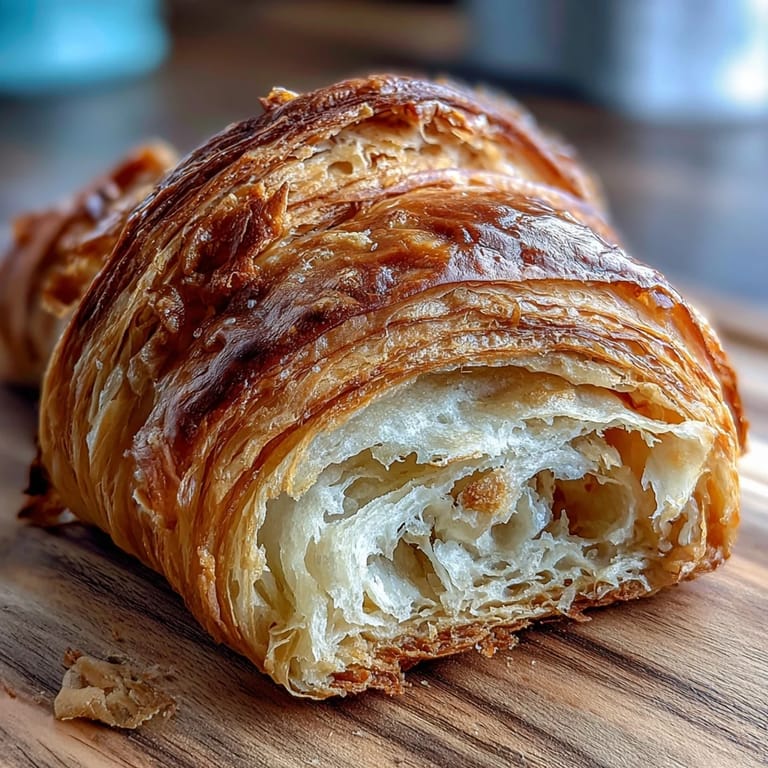
 The real reward isn't just the taste, though that first crunch when you bite through the golden shell is genuinely unforgettable. It's the quiet satisfaction of pulling something so elegant and impressive from your own hands, knowing you built those layers yourself, one patient fold at a time.
Why Sourdough Changes Everything
Regular croissants are buttery and delicious, but adding sourdough starter transforms them into something with actual personality. The starter contributes a gentle tang that plays beautifully against the rich butter, and the long fermentation develops complexity you can't rush. I used to think sourdough croissants were just a trendy thing, until I tasted the difference side by side—there's no going back.
The Lamination Game
Laminating is really just a controlled conversation between butter and dough—you're trying to keep them separate so they create layers, but if the conversation gets too heated (temperature rises too much), everything breaks down. When I started treating the butter block like it needed to stay cold and cooperative, suddenly my croissants went from decent to restaurant-quality. The key is respecting the process and not rushing the chills, even when you're excited to move forward.
Timing and Flexibility
The beauty of this recipe is that almost every step can be extended without hurting the result—if you can only chill for 1.5 hours instead of 2, that's fine; if you need to leave your croissants proofing for 4 hours instead of 3, they'll just be extra puffy and delicate. The overnight step is flexible too; I've done 6 hours and 14 hours, and both produced incredible croissants. This flexibility means you can actually fit croissant-making into a real life instead of rearranging your entire schedule.
- If your kitchen is very warm, your butter will soften faster—chill everything longer and work in shorter bursts.
- Croissants can be frozen after shaping (before the final proof) and baked directly from frozen; just add 5-10 minutes to baking time.
- Leftover croissants reheat beautifully in a 160°C (320°F) oven for 5-8 minutes, though they're honestly best fresh.
 Pin It
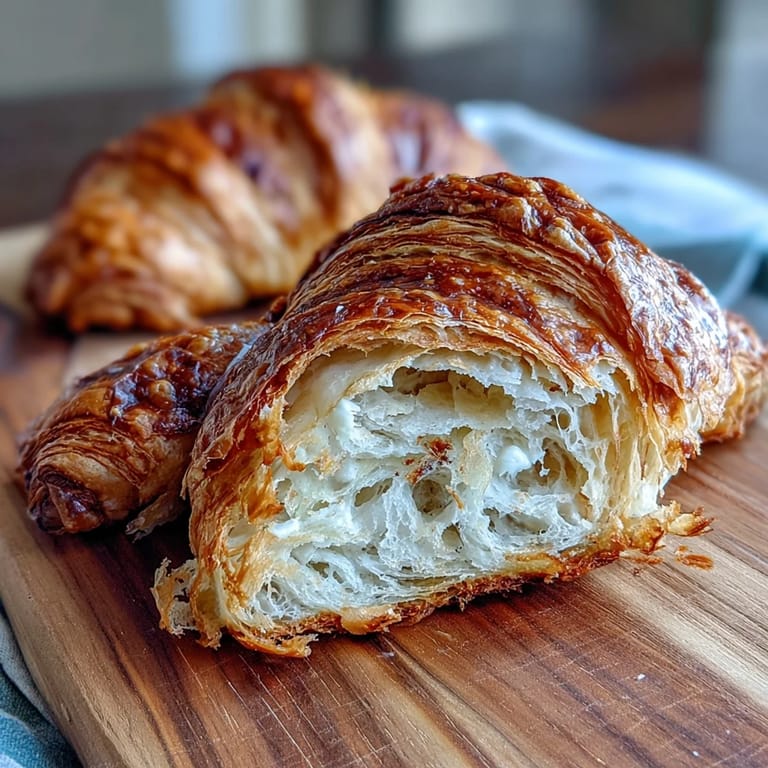
 Making croissants from scratch is actually less intimidating than it sounds once you understand that patience and cold temperatures are doing most of the work. The next time someone tells you they could never make croissants, hand them this recipe—it's an invitation to discover that they can.
Recipe FAQs
- → How does the sourdough starter affect the flavor?
The sourdough starter adds a mild tang and complexity to the dough, enhancing the overall taste and contributing to a tender crumb.
- → Why is the dough chilled multiple times?
Chilling between folds firms the butter and relaxes the gluten, allowing the layers to develop and resulting in a flaky texture.
- → What’s the purpose of the folding technique?
Folding creates layers of dough and butter that puff up during baking, producing the croissant’s characteristic flakiness.
- → Can the croissants be frozen after baking?
Yes, baked croissants freeze well and can be reheated gently to preserve their crispness and flavor.
- → How long should the croissants proof before baking?
Proof until doubled in size, typically 2-3 hours at room temperature, to achieve a light and airy texture.